Utopia
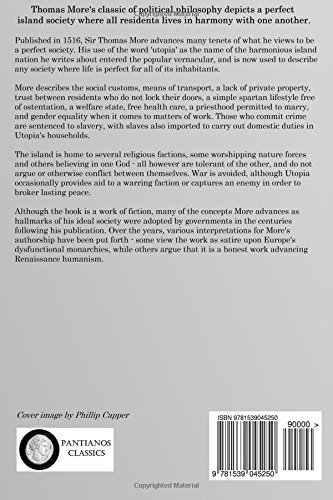
Thomas More Utopia pdf - Utopia a été écrit par Thomas More qui connu comme un auteur et ont écrit beaucoup de livres intéressants avec une grande narration. Utopia a été l'un des livres de populer sur 2016. Il contient 102 pages et disponible sur format . Ce livre a été très surpris en raison de sa note rating et a obtenu environ avis des utilisateurs. Donc, après avoir terminé la lecture de ce livre, je recommande aux lecteurs de ne pas sous-estimer ce grand livre. Vous devez prendre Utopia que votre liste de lecture ou vous serez regretter parce que vous ne l'avez pas lu encore dans votre vie.Rang parmi les ventes Amazon: #44659 dans LivresPublié le: 2016-09-23Langue d'origine: AnglaisDimensions: 9.00" h x .23" l x 6.00" L, Reliure: Broché102 pagesExtraitThis Dark WorldThe infant was taken, within a week of its birth, to the precincts of the church; the child of wrath must be reformed into the image of God, 'the servant of the fiend' made into 'a son of joy'. At the church-door the priest asked the midwife if the child were male or female, and then made a sign of the cross on the infant's forehead, breast and right hand. He placed some salt in the baby's mouth according to custom; then the priest exorcised the devil from its body with a number of prayers, and pronounced baptism as the sole means 'to obtain eternal grace by spiritual regeneration'. The priest spat in his left hand and touched the ears and nose of the child with his saliva. Let the nose be open to the odour of sweetness. It was time to enter the church itself, the priest taking the right hand of the new-born child who had with the salt and saliva been granted the station of a catechumen. The litanies of the saints were pronounced over the baptismal font; the priest then divided the water with his right hand and cast it in the four directions of the cross. He breathed three rimes upon it and then spilled wax in a cruciform pattern. He divided the holy water with a candle, before returning the taper to the cleric beside him. Oil and chrism were added, with a long rod or spoon, and the child could now be baptised. Thomas More, what seekest thou? The sponsors replied for the infant, Baptism. Dost thou wish to be baptised? I wish. The child was given to the priest, who immersed him three times in the water. He was then anointed with chrism and wrapped in a chrismal robe. Thomas More, receive a white robe, holy and unstained, which thou must bring before the tribunal of Our Lord Jesus Christ, that thou mayest have eternal life and live for ever and ever. The candle was lit and placed in the child's right hand, thus inaugurating a journey through this dark world which ended when, during the last rites, a candle was placed in the right hand of the dying man with the prayer, 'The Lord is my Light and my Salvation, whom shall I fear?' Whom shall this particular child fear, when it was believed by the Church that the whole truth and meaning of baptism was achieved in the act of martyrdom? 'Baptism and suffering for the sake of Christ', according to a second-century bishop, are the two acts which bring full 'remission of sins'. It was considered best to baptise the child on the same day as its birth, if such haste were practicable, since an infant unbaptised would be consigned to limbo after its death. To leave this world in a state of original sin was to take a course to that eternal dwelling, Limbus puerorum, suspended between heaven, hell and purgatory. There the little unbaptised souls would dwell in happy ignorance beside the more formidable and haunting Limbus patrum, which contained the souls of Noah, Moses and Isaiah together with (in Dante's epic) Virgil, Aristotle, Socrates and all the good men who lived on earth before the birth, death and resurrection of Jesus. Adam had already been dragged from this place at the time of Christ's crucifixion, but there was continual debate within the Church about the consequences of denying new-born children the eternal comfort of paradise. Could a child be saved by the desire, the votum, of its parents? Thomas More himself would eventually concede only that 'those infantes be dampned onely to the payne of losse of heauen'. In various late medieval pictures of baptism, in manuscripts and devotional manuals, the priest stands with his surplice and stole beside the font. Sometimes he seems to be balancing the infant in the palm of his hand, yet the child is so unnaturally large and alert for such an early stage in its life that we can only assume it acquired mental consciousness with its spiritual renovation. A clerk with a surplice stands behind the priest, while two sponsors and the child's father are generally seen beside the font. In some depictions of this first of the seven sacraments, an image of the dying Christ hangs behind the human scene. But the mother was rarely, if ever, present. In the more pious households, she would have worn a girdle made out of manuscript prayer rolls in the last stages of her pregnancy, and it was customary in labour to invoke the name of St Margaret as well as the Blessed Virgin. She remained secluded after giving birth, and two or three weeks later was led out to be 'churched' or purified. When she was taken to the church, her head was covered by a handkerchief, as a veil, and she was advised not to look up at the sun or the sky. She knelt in the church while the priest blessed her and assured her, in the words of Psalm 121, that 'the sun shall not burn her by day, nor the moon by night. It was a ceremony both to celebrate the birth of the child and to give thanks for the survival of the mother. This is the late fifteenth-century world into which Thomas More was baptised.Revue de presse“We can’t do without this book. We are all and have always been Thomas More’s children.” —China Miéville “I am offered the Grand Inquisitor’s choice. Will you choose freedom without happiness, or happiness without freedom? The only answer one can make, I think, is: No.” —Ursula K. Le GuinFrom the Trade Paperback edition.Présentation de l'éditeurThomas More's classic of political philosophy depicts an island society where all residents lives in harmony with one another. Published in 1516, Utopia sees Sir Thomas More advances many tenets of what he views to be a perfect society. His use of the word 'utopia' as the name of the harmonious island nation he writes about entered the popular vernacular, and is now used to describe any society where life is perfect for all of its inhabitants. More describes the social customs, means of transport, a lack of private property, trust between residents who do not lock their doors, a simple spartan lifestyle free of ostentation, a welfare state, free health care, a priesthood permitted to marry, and gender equality when it comes to matters of work. Those who commit crime are sentenced to slavery, with slaves also imported to carry out domestic duties in Utopia's households. The island is home to several religious factions, some worshipping nature forces and others believing in one God - all however are tolerant of the other, and do not argue or otherwise conflict between themselves. War is avoided, although Utopia occasionally provides aid to a warring faction or captures an enemy in order to broker lasting peace. Although the book is a work of fiction, many of the concepts More advances as hallmarks of his ideal society were adopted by governments in the centuries following his publication. Over the years, various interpretations for More's authorship have been put forth - some view the work as satire upon Europe's dysfunctional monarchies, while others argue that it is a honest work advancing Renaissance humanism.
Details of Utopia
| Le Titre Du Livre | Utopia |
| Auteur | Thomas More |
| Vendu par | CreateSpace Independent Publishing Platform |
| EAN | 9781539045250 |
| Nombre de pages | 102 pages |
| Editeur | CreateSpace Independent Publishing Platform |
| Nom de fichier | utopia.pdf |




No comments:
Post a Comment